
4E FIELD NOTES · KNOW YOUR QUARRY
How to Age Whitetail Bucks in Central & South Texas
A big rack catches your attention. A buck’s body tells a more useful story about maturity. Learn what to compare—and when the honest answer is “I need a better look.”
By 4E · Reviewed October 23, 2026
Whitetail buck aging chart: look beyond the rack
This original illustration compares broad age classes, not six guaranteed appearances. Start with the overall silhouette, then compare the features below. Read the captions on your phone or open the illustration for a larger view.
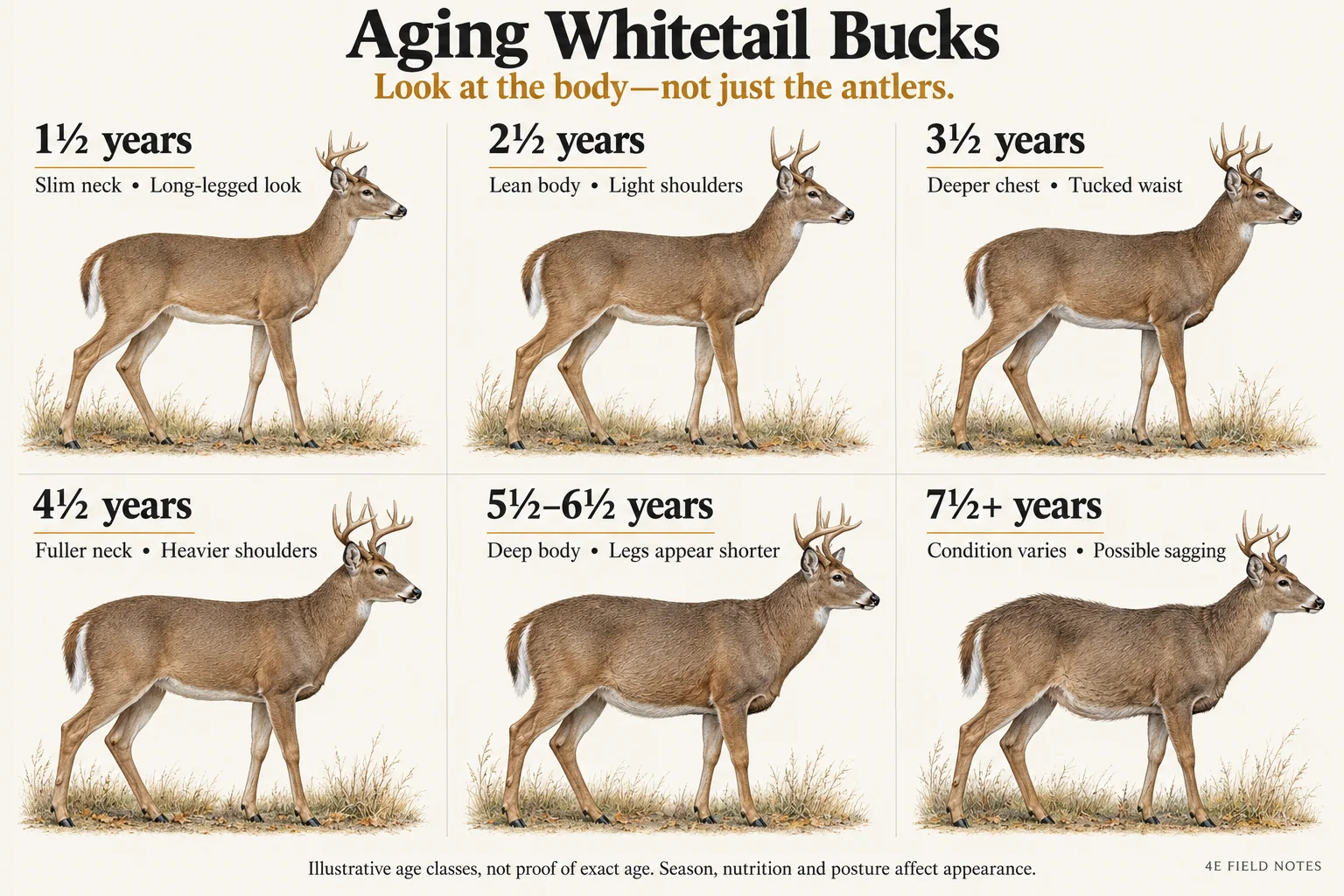
1½ years: youthful proportions
A narrow neck and light chest give a lean, long-legged appearance. The body can resemble a doe’s.
2½ years: filling out
More body mass develops, but shoulders remain relatively light. The waist is lean and the legs still appear long.
3½ years: stronger front end
The chest deepens and the neck gains muscle, especially during the rut. A trim waist usually remains visible.
4½ years: mature-looking frame
Heavier shoulders and a fuller neck create a more solid outline. Legs look more proportionate to the body.
5½–6½ years: deep-bodied maturity
A substantial chest, neck and trunk may make the legs look shorter. The belly may become less tucked.
7½+ years: condition can change
Older bucks may lose muscle or show a sagging belly and back. Those signs are not universal or exclusive to old age.
Body-characteristic guidance: Mississippi Department of Wildlife, Fisheries, and Parks: Aging Bucks on the Hoof.
Aging bucks in Central Texas and South Texas
Do not use a region’s reputation as an age test. A South Texas buck is not automatically older because it carries impressive antlers, and a smaller Hill Country rack does not automatically belong to a young deer.
Texas Parks and Wildlife explains that age and nutrition influence antler development, but individual bucks vary. Some mature animals never develop the antlers hunters expect. Read TPWD’s age-management guidance.
Food conditions matter, too. TPWD’s nutrition research illustrates how diet can influence development. Compare observations from the same ranch and season rather than treating a photograph from a different property as an exact template. Explore TPWD’s deer nutrition information.
For local context, see our Texas deer hunting regions guide. Use it to understand the setting—not to assign a birthday to a buck.
Why the rut can fool your eye
A swollen rutting neck can make a buck appear more mature. Later weight loss can make the same animal look leaner. Posture also changes the outline. Seek a relaxed, broadside view with the head raised before making a comparison.
Season and posture cautions: MDWFP’s field-aging guide.
A practical trail-camera aging checklist
Our suggested routine is deliberately simple. Save the evidence, record uncertainty and compare again rather than forcing a precise number from one blurry frame.
- Choose the clearest broadside frame. Keep the whole body in view, including the legs and back.
- Cover the antlers for your first look. Describe the body before the rack influences your impression.
- Write down three observations. For example: light shoulders, tucked waist and long-legged proportions. Separate what you can see from what you assume.
- Compare several images. Label the date and camera location. Use additional angles to check whether posture created a misleading shape.
- Record a range and confidence. “Likely younger adult; low confidence” is more useful than an unsupported exact age.
- Discuss the animal with the guide. Ask whether the ranch has earlier photographs or records. Keep uncertain animals off a must-harvest list.
Age, antler score and management are different questions
“How old is he?” is not the same as “What does he score?” An antler score measures the rack; an age estimate describes maturity. Neither automatically decides whether that deer fits a particular ranch’s harvest plan.
Keep those discussions separate when choosing a hunt. Ask the outfitter which animals qualify, who makes the final decision and what happens if the intended animal does not appear. Our whitetail scoring tool and management deer hunt guide explain those related topics.
Common questions about aging whitetail bucks
Can I age a buck by its antler points?
No. Point count is not a dependable age calendar. Consider the body and available history instead of assuming an eight-point buck has a particular age.
Can one trail-camera photo prove a buck is 5½?
No. Treat it as an estimate. A useful photo may support a broad age class, but a label such as 5½ should not imply certainty without a reliable known-age history.
Does a sagging belly always mean an old buck?
No. Do not let one feature decide the estimate. Compare the entire animal and account for condition and posture.
Should I harvest a buck because it looks mature?
Not on that observation alone. Confirm the ranch’s criteria and your guide’s approval, and follow the applicable Texas hunting regulations. This article is educational, not permission to harvest a particular animal.
Put the field knowledge to work
Looking for a whitetail hunt in Central or South Texas? Tell us what matters most to you, and ask how the ranch identifies eligible bucks before booking.
Get Whitetail Hunt OptionsText 4E
Prefer a call? 830-282-7879
